How many solar panels do I need?

This question is best answered by asking, how much do you use?

By building a load profile that outlines all the power you intend to consume during a day and estimating the duration of each device and its power draw you can build a power profile. A power bill is similar but not to the same level of detail as it only shows a total for the month which you divide by the number of days in that month. That gives you a kWh value. That number is sometimes referred to as the number of units. It's what you are charged for on your power bill. i.e. 500 units for the month at 20 cents per unit (1 kWh) would be $100. 500 units divided by 31 days equals 16.12 units per day. So that's 16kWh, and in New Zealand, the peak sun hours over winter are only 2 hours. So you'd need an 8kW solar array which will produce on a clear day 8kW per hour and with the 2 hours of usable sun energy in a day you'd generate 16kWh of power.

This would generate enough power to offset your consumption, but it's not all at the right time. You use power at night from the grid so you'll be charged for importing power to your house. But during the day while you aren't at home or your power usage is low you'll be exporting to the grid which may result in you receiving a small credit to your account.

You can see how the real way to benefit from solar is to utilise the sun's energy during the day and limit your need for it at night. This is where batteries can help as they store the day's energy for you to use at night.

Will 540 watts and a big battery bank allow me to go off-grid full time?

We get asked questions like this all the time and I guess most would say yes that will be fine, some might say it depends on your load requirements, few would say no. The answer lies within the maths and calculations of your power consumption which is subtracted from your power generation. To work this out you take the power of each device and how long it's used for to get a daily demand. Now there are also peak loads and hours of minimal usage but for now, let's just work with a total figure for the day then divide that by 24 hours. 

We recently investigated a system where the customer had spent over $6500 on multiple replacement batteries & upgrades to the charging and solar system on top of the base installation the motorhome came with to resolve their shortfall. Only a few years ago a 150W panel and a 220Ah or 260Ah battery were all your motorhome came with which would be considered only a mid-sized occasional off-grid solution now. Many still don't have anything more, especially those vehicles out of Europe built for the rental market unless upgraded locally.

Their new setup included 540W (3 x 180W) Solar panels and 2 x 270Ah AGM batteries, DC charging from the alternator but it turns out they don't actually travel that much. The panels are connected in parallel into a 20A solar controller and they have 50A of AC Battery Chargers they run off a generator if the batteries get low. As it turns out that means they run the generator every second day to ensure they keep the batteries above 12.5 volts so they will get 5 years cycle from them.

With a moderate 5A discharge per hour, 24 hours a day the performance figures of their new system look like this:
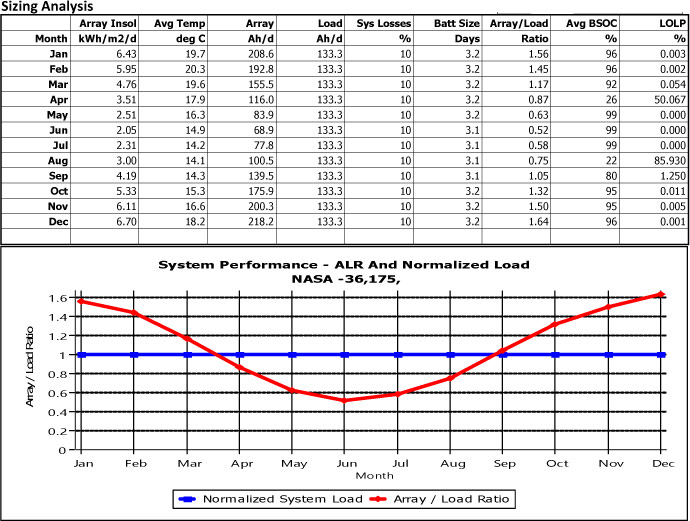
We didn't want to alter the chart in any way to correct the errors we can see but we will explain something to clarify. The last column is headed LOLP meaning Likelihood Of Lost Power. in the months of May through to July there is Zero % of the system working and Battery State of Charge will be 100% discharged. But you will notice in Jan - Mar then Oct - Dec there is less than 1% chance of the system failing. April it's 50/50 and in August an 80% chance based on the last few years sun hours in the Coromandel when the panels are mounted flat on the roof of your motorhome. The reason the chart is displaying errors is nobody with this level of information would actually design-build, or implement a system that is shown to fail. The system would require over 1kW of solar to be able to maintain a 5A continuous load (120Ah but 133.3Ah when losses are included daily). You can see days carry over for the batteries is only 3 days without sun and that in summer months in the southern hemisphere you'd have plenty of excess power.

That might lead some people to figure out that 540W of solar far exceeds the 20A controller included. But over the summer months, the battery will fully recharge from the max 50A discharge from overnight in the first 3 hours of sun in the morning so will be in float mode only supplying discharge load at midday in the full summer sun. With the large array size, you have the benefit of collecting more of the low-level power for longer over the winter months. It's just not enough to meet demand.

5 things you need to know about importance of correct sizing and purpose

  1. When you select a battery charger you need to first choose a style or form that is appropriate for the task at hand. A desktop charger isn't suitable in an application where the charger needs to be retained or mounted. These form factors may include dust or water ingress considerations or power cables in and out of the unit.

  2. When selecting a battery the capacity required for you to run with a few day's autonomy needs to be matched with a batteries need to be recharged with the appropriate sized current. As a general rule we say use 1/10th batteries AH for its charging rate given you have 12 hours to recharge overnight. If you have less time then you need a larger charger if the battery can accept a higher rate of charge. Or if you are using some of the charging power to run equipment while the charging is simultaneously occurring.

  3. The intended use of the battery is a key factor in the life you will get from it if you use a starting battery in a deep cycle application then be prepared for an early end of life. If you have recently increased your Ah capacity because you required a longer autonomy and used a deep cycle battery but have not increased your charging current to match you can also expect issues. Using any battery charger or regulator which doesn't use the factory recommended recharge voltages of the battery you are charging will lead to an early end of life issues also. These are not covered by the manufacturer's warranty which covers physical defects in production.

  4. Chargers are a logic programmed electrical device that uses timers and measurements of voltage and current to determine the charge cycle. They are therefore pre-programmed with time limits for each stage, or current (amps) and a minimum value before the stage is complete then moving to the next stage of a charging cycle. If you haven't sized your charger correctly to your batteries these rates can be either too long because of undercurrent causing issues with recharge. Or just as annoying if the charger is too big you can reach high voltages quickly but not be able to change modes for a minimum number of hours which can lead to unnecessary overcharging.

  5. Purpose of the system design, simplicity, effectiveness, and efficiency are all core factors in power storage and conversion. Choosing the correct components from the outset might cost a little more upfront but the return well worth the effort in getting it right.

Total Loss Ignition Systems

What is a Total Loss Ignition System? Its using a petrol engine without an alternator.

Effectively you are running your vehicle's electronics from your battery which includes any spark to the ignition system, gauges, lights, fans, pumps, transponder or data logger, GPS, radio, comms etc etc.

Again we'd highlight the purpose of this battery is the most critical thing to consider. Do you want to have enough cranking power to start the vehicle or do you need to drive for a few hours without a recharge? (the latter being something to consider if your alternator dies while in competition or along way from home. Its referenced on the specs of a battery as being the reserve capacity (RC). It's measured at 25 amps and simulates SLA which was considered the essential requirement to operate a vehicle some 20 years ago. (Starting, Lights, Accessories). So the 25 amps could be discharged for X number of minutes (i.e. 90RC) until there is no usable voltage remaining in the battery.

With high flow fuel pumps and water cooling systems on high power engines a fully charged 12 volt battery might only be 11.5 volts under discharge load. This is to low a voltage for the ignition system to operate effectively and it makes current draw that much higher that it is far from ideal. An alternative would be to run a higher voltage battery like our XS Power 16 volt battery. Underload the voltage would still be 14 volts which is similar to the voltage output of a high powered alternator without the overhead of the alternator drive belt loading the engine or the extra weight being carried.

This is ideal for systems like drag cars or midget vehicles used in speedway which are push started. The 16 volt batteries also make for excellent jump start batteries on 1400 plus horsepower engines used in Hydroplanes, river racers and jet sprint boats.